DermaPlus Review: When Your Skin No Longer Looks Like “You”
There’s a particular kind of frustration that comes from looking in the mirror and seeing skin that appears more tired than you feel.
You moisturize, drink more water, and try whichever serum is getting attention that month. Yet the dryness creeps back. Makeup settles into fine lines. The area around your eyes looks less smooth, and your skin seems to have lost some of the softness it once had.
It can quietly affect your confidence.
Maybe you avoid bright bathroom lighting. Maybe you’re uncomfortable in close-up photos. Or perhaps you’re simply tired of buying products that promise dramatic changes but end up becoming another half-used bottle in the cabinet.
That’s the emotional pull behind DermaPlus.
BeVital presents it as a topical anti-aging skincare formula based primarily on Moroccan argan oil and ashwagandha liquid extract. The goal is to support hydration, softness, elasticity, and a more even-looking complexion without turning your daily routine into a ten-step project.
But let’s set the hype aside.
DermaPlus isn’t a facelift in a bottle, and no cosmetic oil can permanently erase every wrinkle. What it may offer is a simpler way to moisturize dry skin and support a softer, healthier-looking surface when used consistently.
Here’s what you should know before ordering it.
Check DermaPlus for Softer, More Hydrated-Looking Skin
What Is DermaPlus?
DermaPlus, also written as Derma Plus, is a topical skincare oil or serum sold by BeVital through the official JustBeVital website.
Despite some third-party websites calling it a supplement, it isn’t an oral capsule or powder. It’s designed to be applied directly to the skin as part of a regular skincare routine.
The official sales page focuses heavily on two components:
- Eco-certified Moroccan argan oil
- Ashwagandha liquid extract
The formula is promoted for people concerned about:
- Dry or rough-feeling skin
- Fine lines and crow’s feet
- Dullness
- Uneven-looking texture
- Loss of softness or elasticity
- Visible signs of environmental stress
This is important: DermaPlus is a cosmetic product, not a drug. It’s not intended to diagnose, treat, cure, or prevent a skin disease, and its promotional claims haven’t been evaluated as drug claims by the FDA.
If you’re dealing with eczema, persistent acne, rosacea, unusual pigmentation, or another diagnosed skin condition, speak with a dermatologist rather than relying on a cosmetic serum.
See How DermaPlus May Fit Into Your Skincare Routine
How Does DermaPlus Work?
The basic idea is simpler than the sales page makes it sound.
Your skin has a protective outer barrier that helps keep moisture in and irritants out. As that barrier becomes drier or more disrupted, the skin can look rough, dull, and less plump. Fine lines may also appear more noticeable when the skin is dehydrated.
It helps reduce surface moisture loss
Argan oil acts primarily as an emollient and semi-occlusive oil. In everyday language, that means it helps soften the skin and slow the escape of moisture from its surface.
When dry skin holds on to more water, it often looks smoother and slightly plumper. That can make dehydration lines appear less obvious, even though the product hasn’t permanently removed the underlying wrinkle.
It supplies fatty acids and antioxidant compounds
Argan oil naturally contains fatty acids, tocopherols, and plant compounds with antioxidant properties. These components may support the skin barrier and help protect the skin’s surface from oxidative stress.
That doesn’t make DermaPlus a replacement for sunscreen.
Broad-spectrum sunscreen remains the most important step for limiting preventable photoaging. The American Academy of Dermatology recommends starting an anti-aging routine with sunscreen and moisturizer rather than relying on a specialty serum alone.
Ashwagandha may support visible skin quality
Topical ashwagandha is less established than familiar ingredients such as retinoids, niacinamide, or vitamin C. Still, early evidence is interesting.
A small randomized, placebo-controlled study tested a lotion containing 8 standardized ashwagandha root extract for 60 days. Researchers reported improvements in hydration, elasticity, and transepidermal water loss compared with placebo.
That study doesn’t prove DermaPlus will produce the same results. The concentration and standardization of ashwagandha in DermaPlus aren’t clearly disclosed on the public sales page.
It does, however, offer a reasonable explanation for why this botanical is included.
Check Today’s DermaPlus Bundle Price
DermaPlus Ingredient and Feature Breakdown
The official page doesn’t display a complete, easy-to-audit INCI ingredient panel in the information reviewed for this article. That limits how precisely the formula can be assessed.
The components below include the two promoted ingredients and the naturally occurring constituents or formula features highlighted by the seller.
1. Eco-Certified Moroccan Argan Oil
Argan oil is the main attraction.
It’s rich in emollient lipids and is commonly used to soften dry skin and improve its feel. Published research suggests that topical argan oil may support hydration and barrier function, although the available studies are relatively small.
Its most realistic benefits are:
- Softer-feeling skin
- Reduced tightness caused by dryness
- Better surface moisture retention
- A smoother, more luminous appearance
People with very oily or breakout-prone skin may find facial oils too heavy, so a patch test is sensible.
2. Ashwagandha Liquid Extract
Ashwagandha, or Withania somnifera, is a botanical more commonly associated with oral wellness products. DermaPlus uses it topically.
The manufacturer connects it with antioxidant support and a reduction in visible stress-related aging. Research on topical ashwagandha is still limited, but one 60-day study found encouraging changes in hydration and elasticity.
The realistic takeaway?
Ashwagandha is promising, but it isn’t as well established in skincare as retinoids or daily sunscreen. Its presence makes the formula interesting, not clinically guaranteed.
3. Naturally Occurring Vitamin E
Argan oil naturally contains tocopherols, commonly referred to as forms of vitamin E.
Vitamin E acts as an antioxidant and may help condition the skin. It can be useful in a moisturizing formula, especially when paired with plant oils and fatty acids.
It shouldn’t be interpreted as a stand-alone wrinkle treatment. Its role here is more about supporting softness and protecting the oil-based formula from oxidation.
4. Omega Fatty Acids
The “rich omegas” mentioned on the official page appear to refer to the fatty-acid profile naturally found in argan oil, including oleic and linoleic acids.
These lipids help give argan oil its emollient quality. They can make rough skin feel smoother and may support the outer barrier’s ability to retain moisture.
For dry or mature skin, that can be genuinely helpful.
For congested or highly reactive skin, it may not be the right texture. Natural oils can still cause irritation or breakouts in some people.
5. Antioxidant Plant Compounds
Argan oil and ashwagandha contain various plant-derived antioxidant compounds.
Antioxidants help neutralize unstable molecules associated with oxidative stress. In skincare, they’re generally used to support the skin against environmental exposure and visible dullness.
Still, an antioxidant serum can’t reverse unlimited UV damage. Use DermaPlus alongside a broad-spectrum sunscreen with at least SPF 30 during the day.
6. Peptide-Rich Formula Claims
The official page describes DermaPlus as a “peptide-rich” wrinkle serum and makes references to collagen support.
This is where I’d like more transparency.
The public page doesn’t clearly identify the specific peptide names, their concentrations, or finished-product clinical testing. Without that information, it’s difficult to evaluate the peptide claim with confidence.
Don’t assume topical collagen or peptide language means whole collagen molecules are being rebuilt inside your skin. Cosmetic formulas can improve hydration and the appearance of fine lines, but dramatic structural claims require much stronger evidence.
Before purchasing, check the current bottle or carton for the complete ingredient list.
View Current DermaPlus Availability and Savings
How to Use DermaPlus
Follow the directions printed on your bottle, as formulas and instructions can change.
A conservative routine would look like this:
- Cleanse with a gentle, non-stripping cleanser.
- Pat your skin dry or leave it slightly damp.
- Apply a small amount of DermaPlus.
- Gently press or massage it into the desired areas.
- Let it absorb before applying other products.
- Finish your morning routine with broad-spectrum sunscreen.
If you have sensitive skin, start with one application every other day rather than immediately using it morning and night.
Do a patch test on your inner forearm or behind your ear and wait at least 24 hours. Stop using it if you experience persistent burning, swelling, itching, or a spreading rash.
Avoid direct contact with the eyes and don’t apply the product over broken or infected skin.
Review the DermaPlus Guarantee Before Ordering
The 60-Day Reality Check
Let’s clear up one misleading phrase often used in supplement reviews: topical skincare products don’t need to “build up in your body.”
DermaPlus isn’t an oral supplement.
An oil may make dry skin feel softer relatively quickly because it reduces surface moisture loss. Changes in texture, elasticity, or the visible appearance of fine lines are slower and much less predictable.
That’s why a consistent 60-day trial is more meaningful than judging the formula after three applications.
One small clinical study of an 8 topical ashwagandha lotion assessed its results after 60 days. That study wasn’t conducted on DermaPlus, but it supports using a longer evaluation period for this type of botanical formula.
For a fair trial:
- Take clear, makeup-free photos before starting.
- Use the same lighting and camera position.
- Don’t introduce several other new products at once.
- Apply DermaPlus according to its label.
- Wear sunscreen every morning.
- Compare your skin after 30 and 60 days.
You’re looking for gradual changes in dryness, softness, comfort, and overall texture, not an overnight transformation.
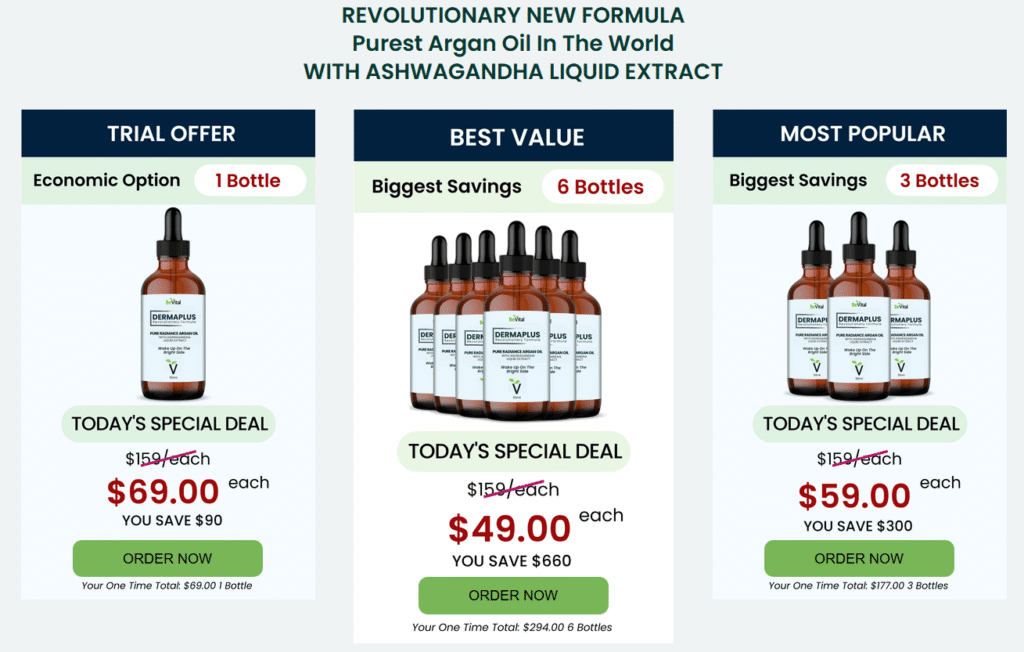
Should you buy three or six bottles?
Only consider a multi-bottle package if all three of these points apply:
- You’ve checked the ingredient label for personal allergens.
- The checkout confirms how long each bottle should last.
- The multi-bottle price offers a meaningful per-bottle saving.
If the official checkout currently offers three- or six-bottle bundles, the three-bottle option is generally the more sensible balance between commitment and cost. A six-bottle package may provide the lowest unit price, but it’s only logical if you already know the formula suits your skin.
Buying six bottles of an untested product isn’t automatically the smartest choice just because the per-bottle price is lower.
Start with a patch test, and don’t let a countdown timer pressure you into purchasing more than you can reasonably use.
Visit the Official DermaPlus Site
DermaPlus Pros and Cons
Pros
- Argan oil has a reasonable basis for moisturizing dry skin
- Contains a less-common botanical ingredient in topical ashwagandha
- Simple concept that may fit into a basic skincare routine
- May improve softness and reduce the look of dehydration lines
- The seller advertises a 100% satisfaction or money-back promise
- Multi-bottle options may lower the cost per bottle
- Doesn’t require a complicated application process
Cons
- The public sales page doesn’t clearly display a complete INCI ingredient list
- Exact ingredient concentrations aren’t readily disclosed
- Finished-product clinical studies weren’t provided on the page reviewed
- Some promotional percentages appear unusually precise without accessible supporting data
- An oil-based formula may feel heavy on oily or acne-prone skin
- Botanical ingredients can still trigger irritation or an allergic reaction
- The guarantee duration and return procedure should be confirmed before ordering
- It won’t replace sunscreen, prescription treatments, or professional dermatology care
Who Is DermaPlus For?
DermaPlus may be worth considering if you:
- Have dry, normal, or mature-looking skin
- Prefer an oil-based product over a lightweight gel
- Want a simple moisturizing step
- Are concerned about dullness or rough texture
- Understand that cosmetic results are usually modest
- Can commit to consistent use for approximately 60 days
- Already use sunscreen and have realistic expectations
It may be especially appealing if your main issue is dehydration. Skin that’s properly moisturized often looks softer, smoother, and less tired.
Who Should Skip It?
DermaPlus probably isn’t the best match if you:
- Expect deep wrinkles to disappear
- Want the stronger evidence available for retinoids
- Have highly oily or congestion-prone skin
- Have a known allergy to argan, ashwagandha, or another listed ingredient
- Are currently experiencing a severe rash or active skin infection
- Need treatment for eczema, rosacea, cystic acne, or suspicious skin changes
- Can’t access a complete ingredient label before buying
- Are uncomfortable with a refund policy that isn’t clearly time-limited in writing
Pregnant or breastfeeding users should show the complete ingredient list to a qualified healthcare professional before use. That’s especially important when a product contains botanical extracts with limited pregnancy-specific topical safety data.
Is DermaPlus Safe?
Argan oil is widely used in cosmetic products, but that doesn’t guarantee every formula will suit every person.
Possible reactions may include:
- Redness
- Itching
- Burning
- Swelling
- Breakouts
- Contact dermatitis
“Natural” doesn’t automatically mean non-irritating. The FDA also doesn’t preapprove most cosmetics before they’re sold, aside from certain color additives.
A patch test is the easiest precaution you can take.
If you have a nut allergy, severely reactive skin, or a history of botanical allergies, speak with a dermatologist or allergist before applying an argan-based product to your face.
Where to Buy DermaPlus
The safest purchasing route is the official JustBeVital DermaPlus website supplied by the seller.
Buying directly matters for a few reasons:
- You can view the current package options.
- You’ll receive the seller’s latest terms.
- You can confirm whether your order qualifies for the refund policy.
- You reduce the risk of receiving an expired, improperly stored, or imitation product.
- You have a clearer path to customer support.
Be careful with marketplace listings using the same product name. “DermaPlus” is used by more than one skincare business, and some unrelated websites describe completely different formulas.
Match the BeVital branding, argan oil and ashwagandha formula, bottle design, and official domain before paying.
DermaPlus Money-Back Guarantee
The official sales page advertises a 100% money-back satisfaction guarantee and says customers may return the bottles if the product doesn’t meet their expectations.
However, the version of the official page reviewed for this article didn’t clearly state whether that guarantee lasts 30, 60, 90, or 180 days.
That detail matters.
Some third-party DermaPlus websites mention a 60-day guarantee, but those pages may refer to another product or may not reflect BeVital’s current terms. Don’t assume a specific refund window based on an unaffiliated review.
Before ordering:
- Read the refund policy shown at checkout.
- Confirm whether the window starts on the purchase or delivery date.
- Check whether empty bottles must be returned.
- Ask whether shipping charges are refundable.
- Save the order confirmation and guarantee terms.
- Note the final return date on your calendar.
A refund promise is only useful when you understand how to claim it.
Final Verdict: Is DermaPlus Worth Buying?
DermaPlus makes the most sense as a botanical moisturizing oil for dry or mature-looking skin.
Argan oil has credible moisturizing potential, and early research on topical ashwagandha is encouraging. Together, they may help skin feel softer, retain moisture, and look smoother with consistent use.
That’s the fair case for it.
The weaker side is transparency. The official sales page makes ambitious claims but doesn’t prominently provide the full ingredient panel, exact concentrations, or finished-formula clinical results needed to verify every advertised benefit.
So my recommendation comes with conditions.
DermaPlus may be worth a careful trial if your primary goals are hydration, softness, and a healthier-looking surface—and if the current price and written refund terms make sense to you.
Don’t buy it expecting permanent wrinkle removal. Don’t stop using sunscreen. And don’t purchase a large bundle until you’ve confirmed the complete formula and return conditions.
Give it a consistent 60-day evaluation, track your results honestly, and judge it by how your own skin responds.
That’s a much better standard than trusting dramatic before-and-after promises.
Visit the Official DermaPlus Site
Affiliate disclosure: This review may contain affiliate links. If you purchase a product through one of these links, we may receive a commission at no additional cost to you. This does not affect the price you pay or the standards we use when reviewing products.
Medical disclaimer: The products discussed on this website are dietary supplements and are not intended to diagnose, treat, cure, or prevent any disease. These products are not substitutes for professional medical advice or prescribed treatments. Always consult a qualified healthcare professional before starting any new supplement, especially if you have a medical condition, are pregnant or breastfeeding, or take prescription medications.